
Sex Offender Checks in Haskell County
The Texas Public Sex Offender Registry is the main public source for Haskell County. The Texas Department of Public Safety manages the free statewide system under Code of Criminal Procedure Chapter 62. Local police chiefs and sheriffs collect registration data, verify it under the applicable schedule, and send it to DPS. A county search can find public entries across Haskell, Rule, Rochester, and rural addresses, while an address search can narrow the view around one place.
Start with the type of question. Use a name search when the person is known. Use the place fields when the goal is neighborhood or community awareness. Compare the returned name, aliases, photo, birth details, address, and offense information before deciding that a result concerns the right person. A map point is not proof that someone is present at that spot now. Read the profile's status and update fields, then call the correct Haskell County registration authority if the facts seem stale.
The official DPS search screen shows how Texas presents the public entry point.
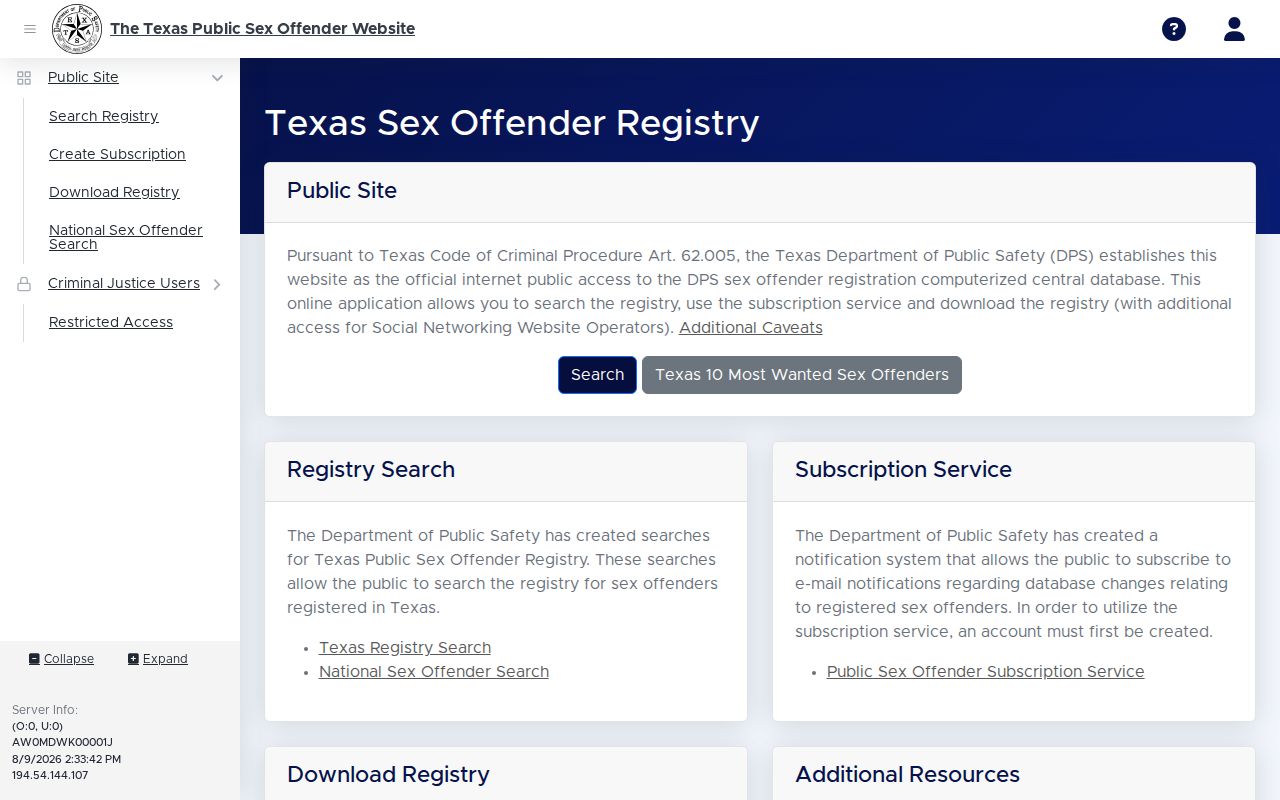
That interface is the county-wide starting point because Haskell County does not publish a separate registry database.
How to Search the Texas Public Sex Offender Registry
DPS permits both person and geographic searches. The most useful Haskell County method is to select the county filter for broad coverage, or enter a full address for a more focused location search. The interface also offers map and list presentations. Radius options can change, so read the live menu instead of relying on an old distance value.
- Open the DPS registry and review its conditions and public-safety warning.
- Enter a last name for a person search, or use address, city, ZIP, and county fields for a place search.
- Select Haskell in the county field when county-wide results are needed, then run the search.
- Compare each candidate's profile details and review registration status before relying on the match.
| Field label | Type | Required | Use |
|---|---|---|---|
| Last Name | Text | Name-search key | Spelling and aliases can affect results |
| First Name | Text | Optional | Narrows a name search |
| Address | Text | Place-search key | Use a complete current address when known |
| City or ZIP | Text or choice | Optional | Narrows the geographic area |
| County | Dropdown | Optional | Select Haskell for county scope |
| Radius | Dropdown | Address mode | Verify current options in the live form |
| View | Control | No | Switches between displayed map and list modes |
A no-result screen is not enough to prove that no public entry exists. Repeat a person search with known aliases or fewer name fields, and try county or address criteria when place is the key fact. If the interface is unavailable, contact DPS or the appropriate Haskell County registering authority rather than substituting an unofficial people-search service.
Cross-State Haskell County Searches
A Texas-only search may be too narrow when someone has lived or worked across state lines. The U.S. Department of Justice operates the National Sex Offender Public Website, known as NSOPW. It federates searches across participating state, territorial, and tribal registries. Use it as another official layer, not as a substitute for reading the source profile maintained by the relevant jurisdiction.
The NSOPW search service provides that national route.
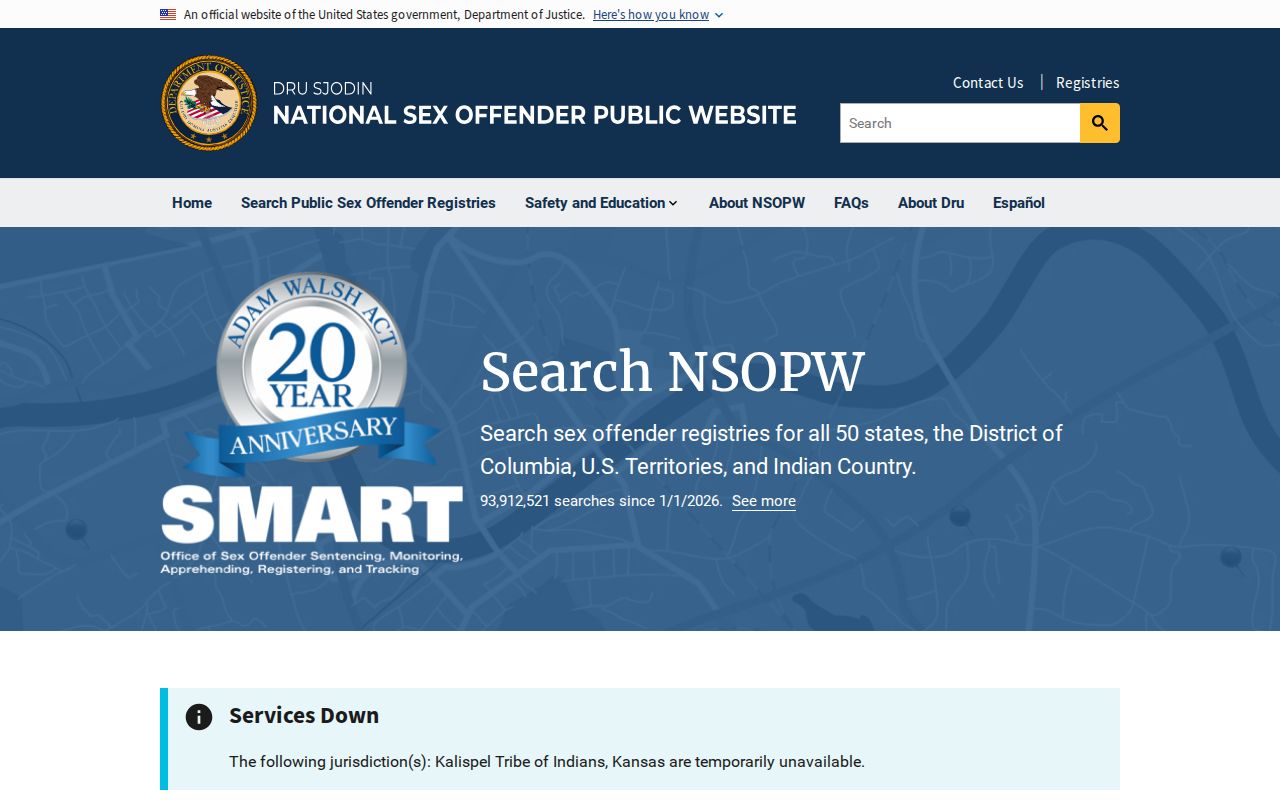
The national search is most useful when a Haskell County result points to prior registration elsewhere or when interstate movement is part of the question.
Inside a Registry Profile
A Texas public profile combines identity, location, offense, and registration information. DPS collects more than it publishes. Protected fields include Social Security and driver's-license numbers, telephone numbers, online identifiers, employer contact data, and information that could identify a victim. Juvenile information may also be made nonpublic by court order. The public subset is meant to identify the registrant and explain the duty without exposing protected people.
| Name and aliases | Displayed name plus public alternate names used to distinguish candidates |
|---|---|
| Photo and descriptors | Color photo, sex, race, age or birth data, height, weight, hair, eyes, and public marks |
| Residence | Public address or location description, subject to the profile's current status |
| Reportable offense | Offense description, statute, conviction or adjudication date, and related public dates |
| Risk information | Risk designation when assigned; this is not a federal tier label |
| Registration status | Registering authority, verification or compliance information, and other public status fields |
| Other public details | Qualifying vehicle, school, institution, punishment, release, or registration data when displayed |
Read each field in context. An offense date, conviction date, release date, and profile update date describe different events. An alias helps match identity but does not show a new case. A location description can also be used when a standard street address is not available.
Haskell County Profile Boundaries
The division between public and private registry data helps readers avoid false inferences. DPS may hold phone numbers, online identifiers, and victim-related details that never appear in the Haskell County search results. Their absence does not mean the registering authority failed to collect them. It means Chapter 62 and DPS publication rules keep them from the public display.
The DPS crime-records laws index ties the registry to the wider Texas disclosure framework.
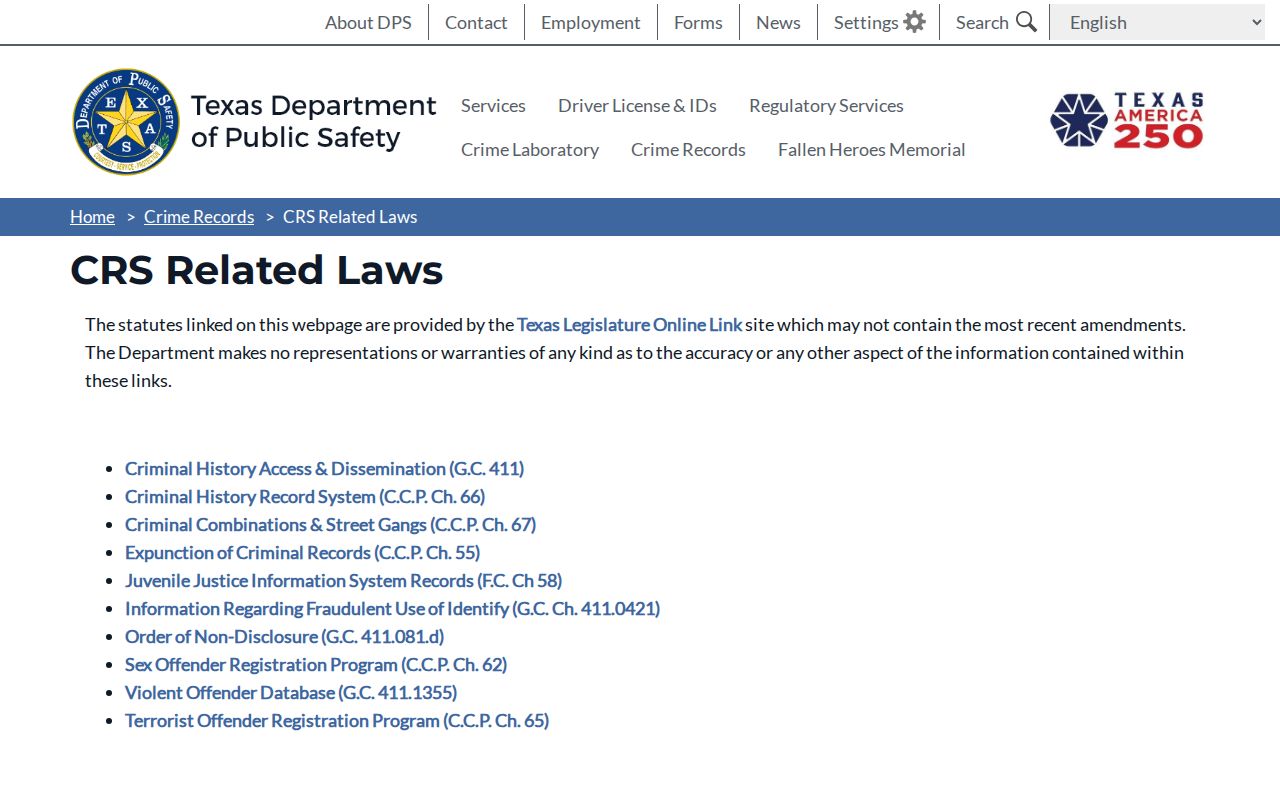
That legal boundary is why a public profile should be read as a defined public subset, not as the agency's full registration file.
Texas Registration Levels and Requirements
Texas does not place every registrant into a simple public Tier I, II, or III scheme. Duration is driven mainly by the reportable offense and statute. Adult duties are generally lifetime or ten years after discharge from supervision. Juvenile periods and court authority differ. Texas risk levels of low, moderate, and high help drive community notification, but those ratings are not the same as federal SORNA tiers.
| Texas category | General duration | Public consequence |
|---|---|---|
| Listed sexually violent and repeat offenses | Lifetime | Chapter 62 sets verification; some high-risk moves trigger bilingual notice |
| Other adult reportable offenses | Generally ten years after discharge | Exact judgment and statute control the duty |
| Juvenile adjudication | Generally ten years after disposition ends | A juvenile court may alter duty or public access |
| Federal, military, foreign, or other-state matter | Depends on Texas comparison | DPS decides substantial similarity or the effect of an outside duty |
The Texas Sex Offender Registration Program overview explains the state framework.
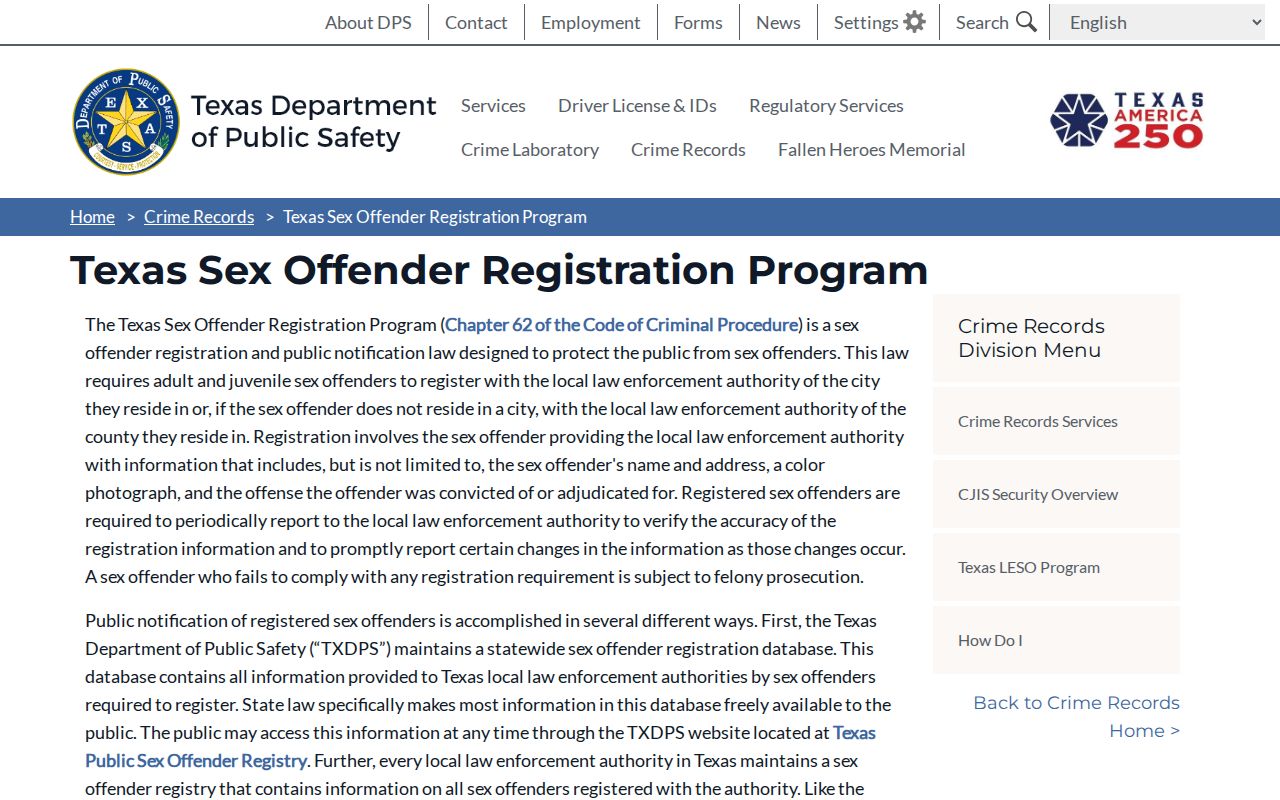
The overview supports checking the exact offense and judgment rather than assigning a tier from a short profile label.
Registration usually must occur by the later of seven days after arrival or the first date permitted by the authority's registration policy. Changes also have statutory reporting schedules. Those rules explain why a profile can display a registration authority and verification data, yet they do not authorize a reader to calculate noncompliance from one old screenshot. Confirm current status through DPS or the local Haskell County authority.
Haskell County Registry Residency Rules
Texas has no single statewide distance rule that applies to every registrant. Municipal ordinances and conditions of parole, probation, or other supervision can set distinct limits. A reader should not assume that a universal 1,000-foot radius governs every Haskell County address. The registry radius tool is a search aid, not a statement that a home violates a law.
For a question about one address, identify whether it is within a city, check the current local ordinance and any known supervision condition through the proper authority, and ask law enforcement about suspected noncompliance. Do not infer a violation from map distance alone. A precise answer can depend on city limits, the type of protected place, the registrant's judgment, and the terms imposed by a court or supervision agency.
Haskell County Registry Notifications
Public notice can occur through several channels. The free DPS database is the broad statewide layer. Local registration authorities maintain their role under Chapter 62. Schools receive notice where the law requires it. DPS may send English and Spanish postcards when a civilly committed sexually violent predator or a person assessed as high risk moves into a community. That special postcard process should not be mistaken for a notice sent for every registrant.
The text of Code of Criminal Procedure Chapter 62 is the direct authority for registration and notification.
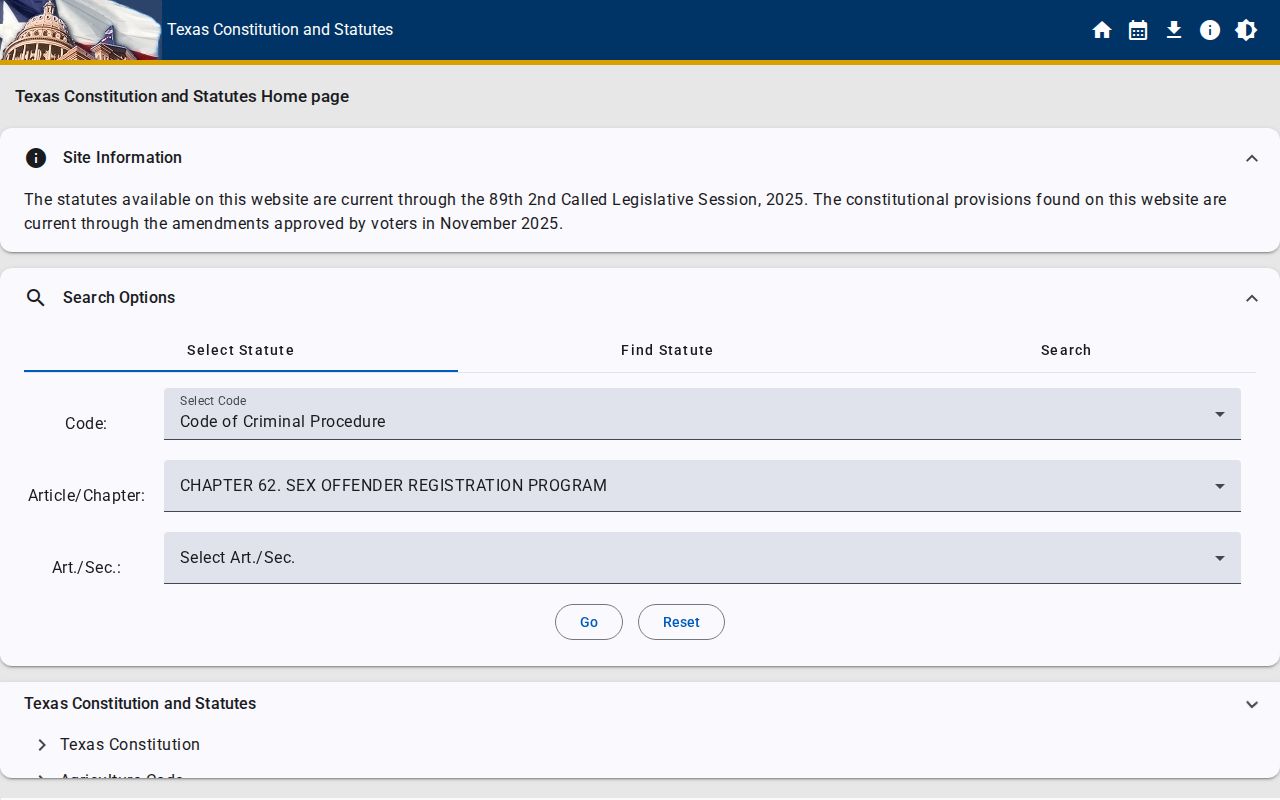
Chapter 62 shows why notice type, registration duration, and verification duties must be tied to the applicable statutory category.
Community Notification and Lawful Use
Registry information supports personal, family, and community safety. Use it to understand a public profile, plan reasonable precautions, or report a specific concern to the proper police or sheriff's office. If a Haskell County address looks stale, review the profile's status and last verification fields, then call the city authority or sheriff. Provide the facts without confronting anyone. The official agency can check information that is not part of the public profile.
Misuse is prohibited: Texas Code of Criminal Procedure Chapter 62 and the DPS registry warning prohibit using registry information to injure, harass, or commit a crime against a registrant. Report concerns to law enforcement instead.
The related Texas criminal-history dissemination law gives further context for restricted and authorized records.
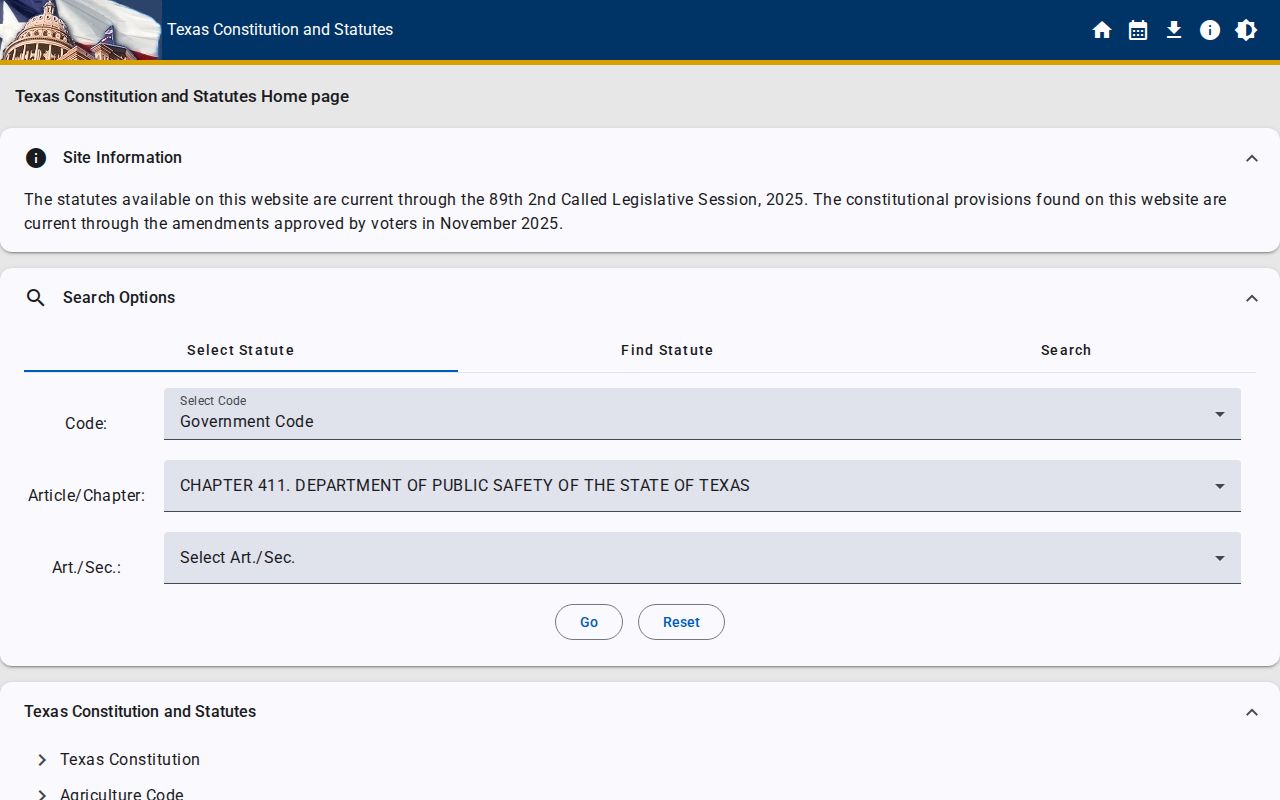
Both sources reinforce a narrow point: public access does not permit threats, vigilantism, or exposure of protected victim information.